Filters
Question type

Study Flashcards

Hydrogen peroxide may decompose to form water and oxygen gas according to the following reaction. 2H2O2(g) Hydrogen peroxide may decompose to form water and oxygen gas according to the following reaction. 2H<sub>2</sub>O<sub>2</sub>(g)    2H<sub>2</sub>O(g) + O<sub>2</sub>(g)  In a particular experiment,1.75 moles of H<sub>2</sub>O<sub>2</sub> were placed in a 2.5-L reaction chamber at 307ºC.After equilibrium was reached,1.20 moles of H<sub>2</sub>O<sub>2</sub> remained.What is K<sub>c</sub> for the reaction? A) 2.0 × 10<sup>-4</sup> B) 2.3 × 10<sup>-2</sup> C) 2.4 × 10<sup>-3</sup> D) 5.5 × 10<sup>-3</sup> E) 3.9 × 10<sup>-4</sup> 2H2O(g) + O2(g) In a particular experiment,1.75 moles of H2O2 were placed in a 2.5-L reaction chamber at 307ºC.After equilibrium was reached,1.20 moles of H2O2 remained.What is Kc for the reaction?


A) 2.0 × 10⁻⁴
B) 2.3 × 10⁻²
C) 2.4 × 10⁻³
D) 5.5 × 10⁻³
E) 3.9 × 10⁻⁴

F) B) and D)
G) All of the above

Correct Answer

verifed

verified

During a chemical reaction,what defines when the concentrations of the reactants and products reach a constant level?


A) Elementary process
B) Reversible reaction
C) Rate law
D) Rate constant
E) Equilibrium

F) C) and D)
G) A) and B)

Correct Answer

verifed

verified

Consider this reaction at equilibrium: 2H2O2(g) Consider this reaction at equilibrium: 2H<sub>2</sub>O<sub>2</sub>(g)    2H<sub>2</sub>O(g) + O<sub>2</sub>(g) ,ΔHº<sub>rxn</sub> = -210 kJ/mol If the volume of the system is expanded at constant temperature,what change will occur in the position of the equilibrium? A) A shift to produce more H<sub>2</sub>O<sub>2</sub> B) A shift to produce more O<sub>2</sub> C) No change will occur. D) A shift to produce less H<sub>2</sub>O E) The pressure decreases. 2H2O(g) + O2(g) ,ΔHºrxn = -210 kJ/mol If the volume of the system is expanded at constant temperature,what change will occur in the position of the equilibrium?


A) A shift to produce more H2O2
B) A shift to produce more O2
C) No change will occur.
D) A shift to produce less H2O
E) The pressure decreases.

F) A) and E)
G) C) and D)

Correct Answer

verifed

verified

For the following reaction at 25ºC,is 3 × 1024. 2SO2(g) + O2(g) For the following reaction at 25ºC,is 3 × 10<sup>24</sup>. 2SO<sub>2</sub>(g) + O<sub>2</sub>(g)    2SO<sub>3</sub>(g)  What is K<sub>c</sub> at this temperature? (R = 0.08206 L • atm/K • mol)  A) 1 × 10<sup>23</sup> B) 1 × 10<sup>24</sup> C) 3 × 10<sup>24</sup> D) 6 × 10<sup>24</sup> E) 7 × 10<sup>25</sup> 2SO3(g) What is Kc at this temperature? (R = 0.08206 L • atm/K • mol)


A) 1 × 10²³
B) 1 × 1024
C) 3 × 1024
D) 6 × 1024
E) 7 × 1025

F) A) and B)
G) B) and E)

Correct Answer

verifed

verified

The reaction 2H2O2(g) The reaction 2H<sub>2</sub>O<sub>2</sub>(g)    2H<sub>2</sub>O(g) + O<sub>2</sub>(g) is exothermic,ΔHº<sub>rxn</sub> = -210 kJ/mol.Which one of the following is correct? A) K<sub>P</sub> at 800 K is smaller than K<sub>P</sub> at 1200 K. B) Temperature does not affect K<sub>P</sub> C) K<sub>P</sub> depends only on the pressure. D) K<sub>P</sub> at 1200 K is smaller than K<sub>P</sub> at 800 K. E) K<sub>P</sub> depends on total pressure as well as temperature. 2H2O(g) + O2(g) is exothermic,ΔHºrxn = -210 kJ/mol.Which one of the following is correct?


A) KP at 800 K is smaller than KP at 1200 K.
B) Temperature does not affect KP
C) KP depends only on the pressure.
D) KP at 1200 K is smaller than KP at 800 K.
E) KP depends on total pressure as well as temperature.

F) D) and E)
G) None of the above

Correct Answer

verifed

verified

Which is correct?


A) If ΔG < 0,then Q > K.
B) If ΔG < 0,then Q < K.
C) If ΔG < 0,then Q = K.
D) If ΔGo < 0,then Q = K.
E) If ΔGo < 0,then Q > K.

F) B) and D)
G) A) and D)

Correct Answer

verifed

verified

Which equation is correct?


A) ΔG = ΔG° - RT logKeq
B) ΔG° = - RT lnK
C) ΔG = RT lnQ
D) ΔG = -RT logQ
E) ΔG° = -RT logKeq

F) C) and D)
G) D) and E)

Correct Answer

verifed

verified

The equilibrium constant for the reaction Ni(s) + 4CO(g) The equilibrium constant for the reaction Ni(s) + 4CO(g)    Ni(CO) <sub>4</sub>(g) is 5.0× 10<sup>4</sup> at 25ºC. What is the equilibrium constant for the following reaction? Ni(CO) <sub>4</sub>(g)    Ni(s) + 4CO(g) ? A) 2.0 × 10<sup>-5</sup> B) 2.5 × 10<sup>9</sup> C) 5.0 × 10<sup>4</sup> D) 5.0 × 10<sup>-4</sup> E) 2.0 × 10<sup>-3</sup> Ni(CO) 4(g) is 5.0× 10⁴ at 25ºC. What is the equilibrium constant for the following reaction? Ni(CO) 4(g) The equilibrium constant for the reaction Ni(s) + 4CO(g)    Ni(CO) <sub>4</sub>(g) is 5.0× 10<sup>4</sup> at 25ºC. What is the equilibrium constant for the following reaction? Ni(CO) <sub>4</sub>(g)    Ni(s) + 4CO(g) ? A) 2.0 × 10<sup>-5</sup> B) 2.5 × 10<sup>9</sup> C) 5.0 × 10<sup>4</sup> D) 5.0 × 10<sup>-4</sup> E) 2.0 × 10<sup>-3</sup> Ni(s) + 4CO(g) ?


A) 2.0 × 10⁻⁵
B) 2.5 × 10⁹
C) 5.0 × 10⁴
D) 5.0 × 10⁻⁴
E) 2.0 × 10⁻³

F) A) and D)
G) B) and C)

Correct Answer

verifed

verified

Consider the equilibrium: A(s) Consider the equilibrium: A(s)   B(s)+ C(g); ΔH°<sub>rxn</sub> > 0 Predict and explain how or whether the following actions would affect this equilibrium. a.adding more solid A b.lowering the temperature c.increasing the pressure on the system by reducing its volume d.adding helium gas to increase the total pressure a.No effect.Pure solids and liquids have constant concentration,regardless of total amount. B(s)+ C(g); ΔH°rxn > 0 Predict and explain how or whether the following actions would affect this equilibrium. a.adding more solid A b.lowering the temperature c.increasing the pressure on the system by reducing its volume d.adding helium gas to increase the total pressure a.No effect.Pure solids and liquids have constant concentration,regardless of total amount.

Correct Answer

verifed

verified

b.By a shift in the exothermic direction...

View Answer

For the reaction 2NOCl(g) For the reaction 2NOCl(g)    2NO(g) + Cl<sub>2</sub>(g) ,K<sub>c</sub> = 8.0 at a certain temperature.What concentration of NOCl must be put into an empty 4.00 - reaction vessel in order that the equilibrium concentration of NOCl is 1.00 M? A) 1.26 M B) 2.25 M C) 2.50 M D) 3.52 M E) 11.0 M 2NO(g) + Cl2(g) ,Kc = 8.0 at a certain temperature.What concentration of NOCl must be put into an empty 4.00 - reaction vessel in order that the equilibrium concentration of NOCl is 1.00 M?


A) 1.26 M
B) 2.25 M
C) 2.50 M
D) 3.52 M
E) 11.0 M

F) B) and E)
G) B) and D)

Correct Answer

verifed

verified

The following reaction is at equilibrium in a sealed container. N2(g) + 3H2(g) The following reaction is at equilibrium in a sealed container. N<sub>2</sub>(g) + 3H<sub>2</sub>(g)    2NH<sub>3</sub>(g) ; ΔH°<sub>rxn</sub> < 0 Which,if any,of the following actions will increase the value of the equilibrium constant,K<sub>c</sub>? A) Adding more NH<sub>3</sub> B) Adding more N<sub>2</sub> C) Increasing the pressure D) Lowering the temperature E) Adding a catalyst 2NH3(g) ; ΔH°rxn < 0 Which,if any,of the following actions will increase the value of the equilibrium constant,Kc?


A) Adding more NH3
B) Adding more N2
C) Increasing the pressure
D) Lowering the temperature
E) Adding a catalyst

F) C) and D)
G) C) and E)

Correct Answer

verifed

verified

For the common allotropes of carbon (graphite and diamond) ,C(gr) For the common allotropes of carbon (graphite and diamond) ,C(gr)    C(dia) with equilibrium constant K = 0.32.The molar volumes of graphite and diamond are,respectively, 5.30 cm<sup>3</sup>/mol and 3.42 cm<sup>3</sup>/mol; ΔHf of diamond is 1.90 kJ/mol.These data suggest that the formation of diamond is favored at A) low temperatures and low pressures. B) high temperatures and low pressures. C) low temperatures and high pressures. D) high temperatures and high pressures. E) None of the is correct. C(dia) with equilibrium constant K = 0.32.The molar volumes of graphite and diamond are,respectively, 5.30 cm3/mol and 3.42 cm3/mol; ΔHf of diamond is 1.90 kJ/mol.These data suggest that the formation of diamond is favored at


A) low temperatures and low pressures.
B) high temperatures and low pressures.
C) low temperatures and high pressures.
D) high temperatures and high pressures.
E) None of the is correct.

F) A) and E)
G) B) and E)

Correct Answer

verifed

verified

The reaction of nitrogen with oxygen to form nitrogen monoxide can be represented by the following equation. N2(g) + O2(g) The reaction of nitrogen with oxygen to form nitrogen monoxide can be represented by the following equation. N<sub>2</sub>(g) + O<sub>2</sub>(g)    2NO(g)  At 2000.°C,the equilibrium constant,K<sub>c</sub>,has a value of 4.10 × 10<sup>-4</sup>.What is the value of K<sub>P</sub>? (R = 0.08206 L • atm/K • mol)  A) 2.17 × 10<sup>-8</sup> B) 4.10 × 10<sup>-4</sup> C) 7.65 × 10<sup>-2</sup> D) 2.20 ×10<sup>-6</sup> E) 2.44 ×10<sup>3</sup> 2NO(g) At 2000.°C,the equilibrium constant,Kc,has a value of 4.10 × 10⁻⁴.What is the value of KP? (R = 0.08206 L • atm/K • mol)


A) 2.17 × 10⁻⁸
B) 4.10 × 10⁻⁴
C) 7.65 × 10⁻²
D) 2.20 ×10⁻⁶
E) 2.44 ×10³

F) A) and E)
G) A) and D)

Correct Answer

verifed

verified

For the following reaction at equilibrium in a reaction vessel,which one of these changes would cause the I2 concentration to increase? 2NOI(g) For the following reaction at equilibrium in a reaction vessel,which one of these changes would cause the I<sub>2</sub> concentration to increase? 2NOI(g)    2NO(g) + I<sub>2</sub>(g) ,ΔHº<sub>rxn</sub> = 45.3 kJ/mol A) Add more NOI B) Add more NO C) Increase the pressure D) Compress the gas mixture into a smaller volume E) Decrease the temperature 2NO(g) + I2(g) ,ΔHºrxn = 45.3 kJ/mol


A) Add more NOI
B) Add more NO
C) Increase the pressure
D) Compress the gas mixture into a smaller volume
E) Decrease the temperature

F) A) and D)
G) None of the above

Correct Answer

verifed

verified

What is the name for Qc?


A) Reversibility expression
B) Reaction expression
C) Equilibrium expression
D) Reaction quotient
E) Mass action

F) A) and E)
G) None of the above

Correct Answer

verifed

verified

A(n)________________ means that the products of the reaction can react to form reactants.

Correct Answer

verifed

verified

Carbon tetrachloride reacts at high temperatures with oxygen to produce two toxic gases, phosgene and chlorine. CCl4(g) + ½O2(g) Carbon tetrachloride reacts at high temperatures with oxygen to produce two toxic gases, phosgene and chlorine. CCl<sub>4</sub>(g) + ½O<sub>2</sub>(g)    COCl<sub>2</sub>(g) + Cl<sub>2</sub>(g) ,K<sub>c</sub> = 4.4 × 10<sup>9</sup> at 1000 K What is K<sub>c</sub> for the following reaction? 2CCl<sub>4</sub>(g) + O<sub>2</sub>(g)    2COCl<sub>2</sub>(g) + 2Cl<sub>2</sub>(g)  A) 6.6 × 10<sup>4</sup> B) 4.4 × 10<sup>9</sup> C) 8.8 × 10<sup>9</sup> D) 1.9 × 10<sup>19</sup> E) 2.3 × 10<sup>-10</sup> COCl2(g) + Cl2(g) ,Kc = 4.4 × 10⁹ at 1000 K What is Kc for the following reaction? 2CCl4(g) + O2(g) Carbon tetrachloride reacts at high temperatures with oxygen to produce two toxic gases, phosgene and chlorine. CCl<sub>4</sub>(g) + ½O<sub>2</sub>(g)    COCl<sub>2</sub>(g) + Cl<sub>2</sub>(g) ,K<sub>c</sub> = 4.4 × 10<sup>9</sup> at 1000 K What is K<sub>c</sub> for the following reaction? 2CCl<sub>4</sub>(g) + O<sub>2</sub>(g)    2COCl<sub>2</sub>(g) + 2Cl<sub>2</sub>(g)  A) 6.6 × 10<sup>4</sup> B) 4.4 × 10<sup>9</sup> C) 8.8 × 10<sup>9</sup> D) 1.9 × 10<sup>19</sup> E) 2.3 × 10<sup>-10</sup> 2COCl2(g) + 2Cl2(g)


A) 6.6 × 10⁴
B) 4.4 × 10⁹
C) 8.8 × 10⁹
D) 1.9 × 10¹⁹
E) 2.3 × 10⁻¹⁰

F) A) and B)
G) A) and C)

Correct Answer

verifed

verified

Calculate KP for the reaction 2NOCl(g) Calculate K<sub>P</sub> for the reaction 2NOCl(g)    2NO(g) + Cl<sub>2</sub>(g) at 400.°C if K<sub>c</sub> at 400.°C for this reaction is 2.1 × 10<sup>-2</sup>.(R = 0.08206 L • atm/K • mol)  A) 6.4 × 10<sup>-3</sup> B) 1.7 × 10<sup>-3</sup> C) 0.69 D) 1.2 E) 3.8 × 10<sup>-4</sup> 2NO(g) + Cl2(g) at 400.°C if Kc at 400.°C for this reaction is 2.1 × 10⁻².(R = 0.08206 L • atm/K • mol)


A) 6.4 × 10⁻³
B) 1.7 × 10⁻³
C) 0.69
D) 1.2
E) 3.8 × 10⁻⁴

F) A) and B)
G) D) and E)

Correct Answer

verifed

verified

Consider the following equilibria: 2SO3(g) Consider the following equilibria: 2SO<sub>3</sub>(g)    2SO<sub>2</sub>(g) + O<sub>2</sub>(g) K<sub>c</sub> = 2.3 × 10<sup>-7</sup> 2NO<sub>3</sub>(g)    2NO<sub>2</sub>(g) + O<sub>2</sub>(g) K<sub>c</sub> = 1.4 × 10<sup>-3</sup> Calculate the equilibrium constant for the reaction SO<sub>2</sub>(g) + NO<sub>3</sub>(g)    SO<sub>3</sub>(g) + NO<sub>2</sub>(g) . A) 78 B) 1.3 × 10<sup>-2</sup> C) 1.6 × 10<sup>-4</sup> D) 3.2 × 10<sup>-10</sup> E) 6.1 × 10<sup>3</sup> 2SO2(g) + O2(g) Kc = 2.3 × 10⁻⁷ 2NO3(g) Consider the following equilibria: 2SO<sub>3</sub>(g)    2SO<sub>2</sub>(g) + O<sub>2</sub>(g) K<sub>c</sub> = 2.3 × 10<sup>-7</sup> 2NO<sub>3</sub>(g)    2NO<sub>2</sub>(g) + O<sub>2</sub>(g) K<sub>c</sub> = 1.4 × 10<sup>-3</sup> Calculate the equilibrium constant for the reaction SO<sub>2</sub>(g) + NO<sub>3</sub>(g)    SO<sub>3</sub>(g) + NO<sub>2</sub>(g) . A) 78 B) 1.3 × 10<sup>-2</sup> C) 1.6 × 10<sup>-4</sup> D) 3.2 × 10<sup>-10</sup> E) 6.1 × 10<sup>3</sup> 2NO2(g) + O2(g) Kc = 1.4 × 10⁻³ Calculate the equilibrium constant for the reaction SO2(g) + NO3(g) Consider the following equilibria: 2SO<sub>3</sub>(g)    2SO<sub>2</sub>(g) + O<sub>2</sub>(g) K<sub>c</sub> = 2.3 × 10<sup>-7</sup> 2NO<sub>3</sub>(g)    2NO<sub>2</sub>(g) + O<sub>2</sub>(g) K<sub>c</sub> = 1.4 × 10<sup>-3</sup> Calculate the equilibrium constant for the reaction SO<sub>2</sub>(g) + NO<sub>3</sub>(g)    SO<sub>3</sub>(g) + NO<sub>2</sub>(g) . A) 78 B) 1.3 × 10<sup>-2</sup> C) 1.6 × 10<sup>-4</sup> D) 3.2 × 10<sup>-10</sup> E) 6.1 × 10<sup>3</sup> SO3(g) + NO2(g) .


A) 78
B) 1.3 × 10⁻²
C) 1.6 × 10⁻⁴
D) 3.2 × 10⁻¹⁰
E) 6.1 × 10³

F) D) and E)
G) A) and B)

Correct Answer

verifed

verified

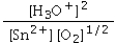
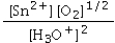
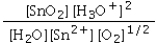
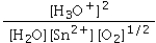
Which is the correct mass-action expression,Qc,for the following chemical reaction? Sn2+(aq) + ½ O2(g) + 3H2O(l) Which is the correct mass-action expression,Qc,for the following chemical reaction? Sn<sup>2+</sup>(aq) + ½ O<sub>2</sub>(g) + 3H<sub>2</sub>O(l)    SnO<sub>2</sub>(s) + 2H<sub>3</sub>O<sup>+</sup>(aq)  A)    B)    C)    D)    E) None of these expressions is correct. SnO2(s) + 2H3O+(aq)


A) Which is the correct mass-action expression,Qc,for the following chemical reaction? Sn<sup>2+</sup>(aq) + ½ O<sub>2</sub>(g) + 3H<sub>2</sub>O(l)    SnO<sub>2</sub>(s) + 2H<sub>3</sub>O<sup>+</sup>(aq)  A)    B)    C)    D)    E) None of these expressions is correct.
B) Which is the correct mass-action expression,Qc,for the following chemical reaction? Sn<sup>2+</sup>(aq) + ½ O<sub>2</sub>(g) + 3H<sub>2</sub>O(l)    SnO<sub>2</sub>(s) + 2H<sub>3</sub>O<sup>+</sup>(aq)  A)    B)    C)    D)    E) None of these expressions is correct.
C) Which is the correct mass-action expression,Qc,for the following chemical reaction? Sn<sup>2+</sup>(aq) + ½ O<sub>2</sub>(g) + 3H<sub>2</sub>O(l)    SnO<sub>2</sub>(s) + 2H<sub>3</sub>O<sup>+</sup>(aq)  A)    B)    C)    D)    E) None of these expressions is correct.
D) Which is the correct mass-action expression,Qc,for the following chemical reaction? Sn<sup>2+</sup>(aq) + ½ O<sub>2</sub>(g) + 3H<sub>2</sub>O(l)    SnO<sub>2</sub>(s) + 2H<sub>3</sub>O<sup>+</sup>(aq)  A)    B)    C)    D)    E) None of these expressions is correct.
E) None of these expressions is correct.

F) A) and C)
G) A) and D)

Correct Answer

verifed

verified

Showing 21 - 40 of 135

Related Exams

Show Answer